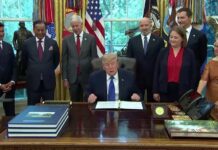
President Trump announced a South Korean plan to pour up to $200 billion into U.S. energy, headlined by new reactors and an Alaska gas pipeline.
Story Highlights
- South Korea’s planned $200 billion U.S. energy package includes Alaska LNG, Texas power, and eight nuclear plants.
- Officials linked the investments to last year’s U.S.–South Korea trade framework covering $350 billion in strategic projects.
- Howard Lutnick outlined a split: $50+ billion for Alaska LNG, $22 billion for Texas power, $120 billion for nuclear.
- Parts of the package remain under discussion, especially final participation in Alaska LNG.
What The White House Announced
President Trump said South Korea will invest up to $200 billion in U.S. energy projects. The package includes the long-delayed Alaska liquefied natural gas project, a large gas-fired power plant in Texas, and eight nuclear power plants across several states. News outlets in Washington and Seoul reported the same headline figure and the same project list soon after the event. The administration cast the package as one of the largest energy infrastructure efforts in modern U.S. history.
Commerce Secretary Howard Lutnick delivered a project-level breakdown during the rollout. He said more than $50 billion would go to the Alaska liquefied natural gas project, about $22 billion to the Texas gas power facility, and roughly $120 billion to nuclear power, including a contingency fund. Coverage identified Interior Secretary Doug Burgum, Energy Secretary Chris Wright, and Alaska Governor Mike Dunleavy as participants or supporters, underscoring the federal and state coordination pitch behind the announcement.
How This Ties To The Trade Framework
U.S. and South Korean reporting linked the energy package to a broader $350 billion strategic investment framework. That framework flowed from a trade deal last year that reduced certain U.S. tariffs while steering capital toward U.S.-based projects. South Korean officials briefed lawmakers that the Encinal, Texas gas-fired power project was the first confirmed effort under the package, with nuclear projects under discussion. The new announcement positions the energy slate as a major early deliverable under that framework.
South Korean and U.S. teams had been working to identify investments before the White House rollout. Reuters reported the Alaska liquefied natural gas project as a centerpiece, alongside electricity generation for fast-growing data center and semiconductor loads in Texas. By bundling nuclear, gas, and pipeline infrastructure, the package attempts to hit reliability, export capacity, and industrial power needs at once. That scope helps explain the large number and the emphasis on jobs and long-term energy security.
Project Details: Alaska LNG, Texas Power, Nuclear Buildout
The Alaska liquefied natural gas plan calls for an approximately 807-mile pipeline from the North Slope to a southern liquefaction terminal, with exports aimed at Asian buyers. Outlets described the project as long delayed and costly, but strategically important for energy trade with Asia. Separate reports have cited allocations of about $50 to $54 billion for Alaska liquefied natural gas, reflecting some variance in estimates at the time of announcement.
6 PM Bottom-of-the-Hour News
President Trump has unveiled a 200 billion dollar package of investments in the U S from South Korea. The president said the package will jump start a long stalled liquefied natural gas project in Alaska: “The colossal package of investments we are… pic.twitter.com/Nh5zKxqdoM
— Worldwide News Network (@WorldwideNNX) September 30, 2026
The Texas project is a roughly 6-gigawatt combined-cycle gas plant designed to serve data centers and chip plants. The nuclear component envisions eight large reactors in several states, which would mark the most ambitious U.S. nuclear build in decades. Together, these projects target firm power for industry, export revenue from liquefied natural gas, and lower-carbon baseload from nuclear energy. These aims speak to shared public concerns over high energy costs, fragile grids, and heavy reliance on imports.
What Is Set And What Comes Next
Published reporting makes clear that some elements are still under discussion. South Korea’s government has not finalized participation in the Alaska liquefied natural gas project, citing profitability reviews. The announcement did not include a public term sheet or a signed project agreement. That said, the Texas gas plant has been identified as a first mover, and the eight-reactor plan frames a nuclear revival path if utilities and vendors align on cost and schedule.
The stakes are large for households and factories that need steady, affordable power. If built, the Texas plant could support the digital and manufacturing boom. If advanced, the Alaska liquefied natural gas project could open a direct export route to Asia. If executed, the nuclear slate could add decades of clean, firm power. Voters across parties often doubt Washington’s follow-through. Clear contracts, timelines, and local hiring plans will be the next test for this “historic” promise.
Sources:
redstate.com, ft.com, msn.com, chosun.com, reuters.com, en.yna.co.kr, local12.com, mk.co.kr
© prospernews.net 2026. All rights reserved.