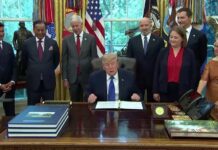

President Trump said top tech leaders signed a “morally binding” accord to police powerful artificial intelligence — without new federal rules — after a White House meeting.
Story Highlights
- Trump said he and major AI company leaders signed a voluntary safety accord at the White House.
- The accord calls for internal and external reviews of new systems before release, according to Trump.
- Trump framed the pact as “morally binding,” likening it to a constitution, though it is not law.
- The approach mirrors past voluntary commitments that advocates called a first step, not a final guardrail.
What The White House Meeting Produced
President Trump hosted top artificial intelligence executives for a White House lunch on Tuesday and emerged saying they had agreed to a voluntary set of safety standards. Trump told reporters the accord will include internal and external reviews of advanced systems, and that industry leaders shared a view that “tremendous self-regulation” is needed. The president emphasized that government agencies like the Department of Justice and the Federal Bureau of Investigation already enforce laws, but he did not back new binding rules at this time.
Trump described the agreement as “morally binding,” and, at one point, compared it to a constitution, but also made clear it is not legally enforceable. House Speaker Mike Johnson stood with Trump and called the document a set of principles and expectations that companies commit to follow on a voluntary basis. C-SPAN footage shows Trump and several executives addressing reporters after the meeting about the new commitments and a new government website that uses artificial intelligence.
Who Was In The Room And What They Agreed To Do
Major technology leaders attended the session, with the White House seeking consensus on steps that reduce risk while keeping the United States ahead of China and other rivals in artificial intelligence. Trump said the standards would require testing systems before release and inviting outside checks to catch safety issues. The plan leans on company-led reviews to flag harms like deception, security flaws, and misuse, and it expects companies to act quickly when problems surface.
Trump and allies described the pact as a way to speed innovation while setting common sense guardrails that do not choke growth. Supporters of this approach argue that fast-moving technology can outrun slow lawmaking, so flexible, voluntary norms can guide behavior now and inform later rules. Trump said he did not want to “stifle” artificial intelligence, and he praised the executives for stepping up to self-police their most advanced tools.
Why Voluntary Accords Keep Coming Up In AI
Voluntary frameworks have become a standard first move in artificial intelligence governance. In 2023, the White House under the prior administration announced nonbinding commitments from several leading companies on safety, security, and trust. Analysts called those a first step toward industry self-governance that might later shape formal standards or laws. Today’s accord echoes that pattern: set baseline practices now, then consider stronger actions when the technology and risks are clearer.
This path matches how standards often evolve. Agencies, companies, and experts agree on shared practices, then bodies like the National Institute of Standards and Technology help translate them into technical guidance. Over time, Congress or regulators can convert parts into enforceable rules. Because this meeting produced a voluntary pact, its impact depends on whether companies follow through and whether the government later codifies pieces into policy.
The Stakes For Americans And The Economy
Artificial intelligence powers tools that touch jobs, health care, banking, and national security. Breakdowns can spread fast and hurt trust. Trump and tech leaders say internal and outside reviews can catch dangers early without freezing progress. That is appealing to many who worry Washington moves too slowly and serves the well connected first. It also speaks to citizens who feel the government has failed to keep big players honest across many sectors.
Trump released the “White House Accord on Super Intelligence,” a joint commitment to frontier-AI safety controls signed by Trump and executives from Google, Anthropic, Meta, OpenAI, xAI and NVIDIA. pic.twitter.com/ZU48i9C5mE
— Caktus Jxck🌵 (@CaktusJxck) September 29, 2026
Americans on the right and left share concerns about runaway technology, lost jobs, bias, and data abuse. A voluntary pact may calm some fears if companies deliver real testing and clear warnings before launch. But it also puts the burden on the same firms that profit from rapid rollout. That is why many will watch whether these promises lead to safer products, transparent audits, and, when needed, firm rules that match the scale of the risk.
What To Watch Next
Watch for written standards that spell out how internal and external reviews will work, what tests will run, and how results will be shared. Look for whether companies pause or change releases when reviews flag serious safety issues. Track whether Congress asks for regular reporting, or whether agencies issue guidance that builds on the accord. Finally, note if this pact becomes the bridge to future rules, as past voluntary commitments sometimes have, but not always.
Sources:
forbes.com, pbs.org, abc17news.com, politico.com, c-span.org, cnbc.com, cbsnews.com
© prospernews.net 2026. All rights reserved.