

(ProsperNews.net) – Minnesota man charged with death penalty eligible federal crimes after murdering State Representative Melissa Hortman and attempting to assassinate State Senator John Hoffman in politically motivated attacks.
Key Takeaways
- Vance Luther Boelter, 57, faces federal death penalty charges for the murder of State Rep. Melissa Hortman and her husband, and the attempted murder of State Sen. John Hoffman and his wife.
- The shootings occurred at the lawmakers’ homes in Brooklyn Park and Champlin in the early morning hours of June 15, 2025, prompting a two-day manhunt.
- Boelter, a former member of Minnesota’s Governor’s Workforce Development Council with no prior criminal record, reportedly had a “list of targets” suggesting more attacks were planned.
- Federal prosecutors have taken the unusual step of pursuing death penalty eligible charges despite Minnesota having abolished capital punishment at the state level in 1911.
- Authorities are investigating whether the attacks were motivated by personal grievances or ideological reasons, noting Boelter was a Trump voter in the 2024 election.
Deadly Assault on Democratic Leadership
In a shocking escalation of political violence, 57-year-old Vance Luther Boelter has been charged with federal murder and stalking charges that could result in the death penalty following targeted attacks on two prominent Minnesota Democratic lawmakers. The deadly rampage began in the early morning hours of June 15, when Boelter allegedly shot and killed State Representative Melissa Hortman and her husband Mark at their Brooklyn Park home around 3:35 a.m., before attacking State Senator John Hoffman and his wife Yvette at their Champlin residence about an hour and a half earlier.
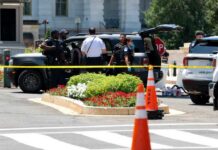
The brutal nature of the attacks has sent shockwaves through Minnesota’s political establishment. Acting U.S. Attorney Joe Thompson emphasized the severity of the federal charges, which relate to both the killings of the Hortmans and the shootings of the Hoffmans who survived but sustained serious injuries. Law enforcement officials revealed that Boelter had a list of additional targets, suggesting he intended to carry out further attacks before being intercepted by police who exchanged gunfire with him as he fled the Hortman residence.
Manhunt Ends with Quiet Surrender
Following the shootings, Boelter managed to evade capture for over 48 hours, triggering an FBI-managed manhunt with a $50,000 reward for information leading to his arrest. The search involved multiple law enforcement agencies and extensive resources as authorities raced to apprehend the suspect before he could potentially strike again. The breakthrough came when Boelter was spotted via trail cameras near his farm in Green Isle, Minnesota, where he ultimately surrendered without resistance.
During the manhunt, authorities detained Jenny Boelter, the suspect’s wife, along with three relatives in Mille Lacs County. Law enforcement has not yet clarified whether she had any involvement in the attacks or was aware of her husband’s plans. The detention of family members highlights the comprehensive approach taken by authorities to prevent any possible accomplices from aiding the suspect’s escape or carrying out additional attacks.
Federal Death Penalty Charges in a Non-Death Penalty State
In an unusual legal development, Boelter faces potential capital punishment despite Minnesota having abolished the death penalty in 1911. This is possible because the charges have been filed at the federal level, where the death penalty remains an option for certain crimes. The decision to pursue federal charges rather than relying solely on state prosecution underscores the gravity with which federal authorities view attacks on elected officials.
At the state level, Boelter has been charged with first-degree murder and attempted murder, which carry a maximum sentence of life imprisonment without parole in Minnesota. The dual-track prosecution ensures that Boelter will face the most severe consequences possible under both state and federal law. He made his first appearance in federal court on June 16 but did not enter a plea, with his next hearing scheduled for June 27.
Political Motivations Under Investigation
While authorities have not officially confirmed a political motive for the attacks, several factors suggest ideological elements may have played a role. Sources indicate that Boelter voted for Donald Trump in the 2024 election, and his targets were both prominent Democratic lawmakers. Melissa Hortman served as the Minnesota House Minority Leader, while John Hoffman was a respected State Senator representing the Champlin area.
Investigators are examining whether the attacks were premeditated due to personal grievances or ideological reasons. Boelter’s background as a former member of Minnesota’s Governor’s Workforce Development Council from 2016 to 2023 suggests he had some familiarity with state government operations. Despite owning firearms, he had no prior criminal record that might have predicted such violence.
Governor Tim Walz described the shootings as “unthinkable” and praised the multi-agency effort that led to Boelter’s capture. “These attacks strike at the heart of our democratic system,” Walz stated. “When elected officials cannot feel safe in their own homes, the foundations of our republic are threatened.”
Growing Concerns About Political Violence
The targeted assassinations in Minnesota represent a disturbing escalation in political violence across America. Coming just months after the attempted assassination of former President Donald Trump during a campaign rally in Pennsylvania, these attacks highlight the increasingly dangerous environment for public officials. Law enforcement agencies nationwide have been on heightened alert for politically motivated violence, particularly as the country navigates a period of intense polarization.
The case has drawn national attention not only for its shocking nature but also for the questions it raises about the security of elected officials at the state level, who typically have far less protection than federal officials. Many state legislatures across the country are now reviewing their security protocols and considering additional measures to protect lawmakers, particularly those who may be targeted for their political positions or policy decisions.
Copyright 2025, ProsperNews.net