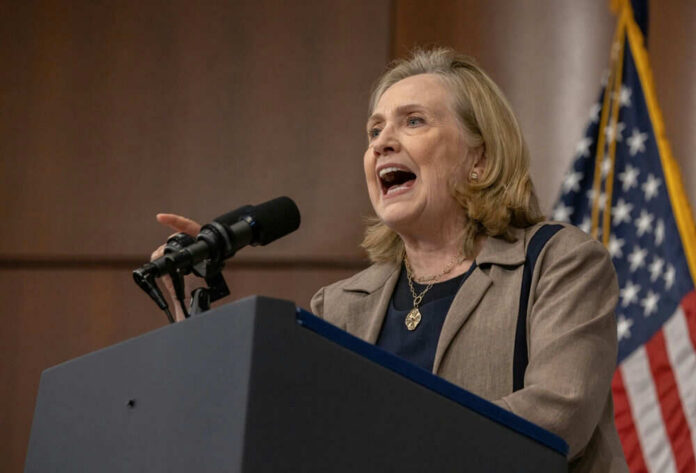
(ProsperNews.net) – Hillary Clinton is back in the headlines with a familiar playbook: branding Republicans “politically brain-dead” on family policy while the White House argues its affordability agenda is already delivering results.
Story Snapshot
- Clinton used a New York Times op-ed to accuse Republicans—including Vice President JD Vance—of obsessing over birthrates while ignoring the cost pressures crushing families.
- She labeled the GOP approach “substantively and politically brain-dead,” and claimed it is rooted in “nostalgia and misogyny,” arguing it implies women should “know their place.”
- The Trump White House responded by pointing to its record on fertility drug prices, child tax credits, and school choice.
- The clash spotlights a broader 2026 fight over whether Washington should prioritize cultural narratives or measurable affordability outcomes for parents.
Clinton’s op-ed targets Republicans’ cultural framing on family life
Hillary Clinton’s latest attack landed through an op-ed published Thursday in The New York Times, where she criticized national Republicans and right-leaning groups for what she described as an obsession with birthrates. Clinton singled out Vice President JD Vance by name and argued the GOP is not meeting families where they are—at the grocery store, the rent payment, the child-care bill—when costs remain high for many households.
Clinton’s sharpest language centered on motives and social values rather than line-by-line policy text. She described the Republican approach as “substantively and politically brain-dead” and tied it to “nostalgia and misogyny,” framing the debate as an attempt to roll back modern expectations about women’s work and independence. Her argument positioned Democrats as the party that should run on a “kids agenda” built around direct cost relief and public benefits for parents.
White House rebuttal emphasizes cost-of-living policy claims, not rhetoric
The Trump administration responded quickly through White House spokesman Kush Desai, who dismissed Clinton’s criticism as a recurring pastime and defended the administration’s family-policy record. Desai highlighted actions the White House says it has taken on fertility drug pricing, child tax credits, and school choice. That response also underscored a governing reality in 2026: Republicans may control Congress and the presidency, but every major family-policy argument still gets filtered through partisan media combat.
The immediate back-and-forth also reveals a strategic divide. Clinton’s message leans on the idea that cultural concerns about marriage, fertility, and traditional roles are distractions from affordability. The White House message leans on measurable outcomes and programmatic achievements it says reduce pressure on parents. With limited source material available beyond the initial report and the administration response, the public still lacks a single, agreed-upon scorecard showing which side’s approach is materially improving family finances.
Why “affordability” fights keep turning into “identity” fights
Family affordability is one of the few issues that regularly crosses ideological lines: conservatives worry about wages, housing costs, and the tax burden; liberals worry about child care, health costs, and inequality. Clinton’s approach tries to connect those pressures to a moral story about women and power. Republicans, meanwhile, often argue that culture and family structure matter because they shape long-term stability. The result is a recurring stalemate where each side talks past the other.
For voters frustrated with government dysfunction, this is the familiar frustration: Washington leaders often spend more time litigating each other’s motives than clarifying what will actually change for parents next month. When a national debate becomes a referendum on whether one party is “misogynistic” or the other is “anti-family,” it can crowd out practical questions—who pays, what it costs, how it’s administered, and whether the benefits reach working families without expanding bureaucracy.
A familiar Clinton-versus-Trump dynamic returns ahead of election season
Clinton’s rhetoric also echoes an older pattern from her 2016 campaign, when her “basket of deplorables” remark became a symbol of how political elites sometimes talk about the other side. This time, her target is narrower—Republican leaders and organizations, not ordinary voters—but the tone is still confrontational. That matters because the country’s trust gap is not just between left and right; it is also between everyday citizens and institutions that feel insulated from the consequences of bad policy.
Looking ahead, the debate is likely to harden around competing definitions of “pro-family.” Democrats, as Clinton describes, emphasize tax credits, paid leave, early childhood investments, and other supports. Republicans emphasize affordability measures plus policies like school choice, while also speaking to broader concerns about demographics and family formation. For Americans who believe the federal government too often fails them, the key question is whether either party can deliver clear, verifiable gains—without turning every kitchen-table issue into another elite culture war.
Sources:
Hillary Clinton accuses GOP ‘politically brain-dead’ on family affordability
Copyright 2026, ProsperNews.net