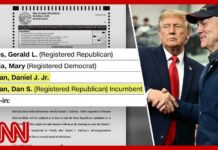

With two nearly identical “Dan Sullivan” names on Alaska’s Senate ballot, the Justice Department moved to pause certification under narrow conditions, arguing voters may have been misled.
Story Highlights
- Justice Department asked a federal court to block certification only if a specific loss scenario occurs.
- The case centers on possible confusion between incumbent Sen. Dan S. Sullivan and Daniel J. Sullivan Jr..
- Alaska officials say ballots clearly distinguished the two and ranked-choice voting reduces confusion.
- Reports allege the second Sullivan was recruited; denials and legal pushback followed.
What the Justice Department Asked the Court to Do
The Department of Justice filed a pre-election lawsuit targeting a specific outcome in Alaska’s Senate race. The filing seeks a preliminary injunction to delay certification only if Senator Dan S. Sullivan does not win, and only if reassigning votes cast for Daniel J. Sullivan Jr. would have changed the ranked-choice result in the incumbent’s favor. The department also asked to preserve time for an investigation into whether some voters meant to choose the incumbent but selected the similarly named candidate.
The request aims to act before certification locks in results. Officials argue that once certified, the harm to voters who meant to support the incumbent cannot be fixed. The department framed the ask as narrow and tied to Alaska’s ranked-choice mechanics. It does not seek a redo of the election or a broad delay. It seeks a pause only under defined conditions about who won and how reallocated rankings could have changed the outcome.
Why Two Sullivans on One Ballot Raised Alarms
The ballot listed the incumbent as “Dan S. Sullivan,” a Republican and the sitting officeholder, and listed “Daniel J. Sullivan Jr.” with no party label. The Justice Department argued this similarity could confuse voters scanning a crowded ballot or relying on name recognition. Independent reporting added fuel by describing claims that allies of Democratic Representative Mary Peltola helped recruit the second Sullivan, though those accounts rely on secondary coverage and not public documents.
The state’s process already faced scrutiny. Alaska’s Division of Elections first concluded Daniel J. Sullivan’s candidacy aimed to confuse voters. A Superior Court judge reversed that decision, and the Alaska Supreme Court allowed him on the ballot. Daniel J. Sullivan denied he ran to mislead anyone. Peltola and her campaign denied any role in recruiting him or ties to either Sullivan campaign. Those denials, and the court rulings, shaped the pushback to federal intervention.
Alaska’s Response: Clear Labels and Ranked-Choice Safeguards
Alaska officials told the court they already took steps to make the names distinct on the ballot. They highlighted labels showing party registration and the word “incumbent” next to Senator Sullivan, while noting the other candidate appeared without a party. They argued the state’s ranked-choice system lets a voter rank both Sullivans. If the non-incumbent is eliminated, that ballot can transfer to the incumbent, which reduces the risk that a mistaken first choice becomes a lost vote.
There is a plausible but not automatic case for disqualification (or “recusal”) of Elias Law Group lawyers from the Alaska DOJ litigation, based on the reported involvement in the decoy-candidate effort; there is not a clear case for judicial recusal of the assigned judge on the…
— kotalo (@edkotalo) October 31, 2026
State lawyers also challenged the lawsuit’s legal footing. They said the federal government lacks standing and that the injunction would violate ballot secrecy by trying to probe individual voter intent after the fact. Legal analysts called the request unusual because it tries to condition certification on a counterfactual reallocation of votes, assuming all ballots for Daniel J. Sullivan reflect intended support for the incumbent—an assumption not yet backed by voter affidavits or data.
What Is Known, What Is Not, and Why It Matters
The record so far shows a plausible source of confusion, a narrow remedy tied to ranked-choice rules, and a state that says its ballot design solved the problem. What is missing are hard measures of voter intent: sworn voter statements, survey data, or ballot-level analysis that could prove confusion changed the outcome. Without that, the case tests a core tension: protect voters from misleading conditions without breaking secrecy rules or guessing voter intent.
The stakes go beyond Alaska. Voters on the right and left worry that political insiders game the rules while agencies move only when it benefits their side. This episode cuts both ways. A Justice Department push, publicly linked to President Trump’s direction, risks looking partisan to critics. Yet alleged recruitment of a same-name “decoy” also looks like insider trickery if proven. The common concern is trust: clear ballots, clear rules, and results that do not depend on guesswork after Election Day.
Sources:
youtube.com, factcheck.org, apnews.com, cnbc.com, news.harvard.edu, abcnews.com, poynter.org, adn.com, alaskapublic.org, onlinelibrary.wiley.com
© prospernews.net 2026. All rights reserved.