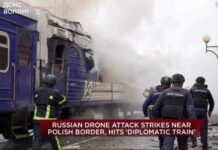

Ukraine says a Russian ballistic missile hit a Kyiv-region defense event, killing at least 10 and injuring many more, while Moscow insists it was striking military industry sites.
Story Snapshot
- Ukrainian officials say a defense-industry event near Kyiv was struck, with at least 10 dead and up to 100 injured.
- Russia says its recent Kyiv-area operations targeted defense-industry facilities and related sites.
- Reports vary on exact location and casualty counts, reflecting war-zone uncertainty.
- The strike fits a wider pattern of large missile-and-drone barrages around Kyiv this summer.
What Ukraine and Russia Each Say About the Target
Ukrainian government and industry representatives said a Russian missile hit a site in Kyiv Oblast where a defense event was underway, reporting at least 10 dead and many wounded. Some outlets described the location as an arms exhibition or training ground. Russia, by contrast, has repeatedly framed its recent strikes around Kyiv as attacks on defense-industry facilities and related infrastructure, saying these were precision operations using long-range weapons. These claims set up a familiar wartime dispute over the nature of targets.
Details about the exact venue remain inconsistent across reports. Some say it was in the Kyiv region or Bucha district. Others call it a training area or an exhibition site. Casualty counts also differ, ranging from six to at least ten dead, with injuries from dozens to near one hundred. This range reflects the fog of war. Early numbers often change as rescue work ends and officials verify identities. That uncertainty does not erase the core fact: a lethal strike hit a defense-linked gathering.
How This Strike Fits a Larger Summer Pattern
The attack did not occur in isolation. Kyiv has faced several large missile and drone barrages in recent weeks. Newsrooms described waves of long-range weapons, air alarms, and fires across the city and suburbs. Russia has warned of “systematic strikes” on defense-linked sites around Kyiv. It also urged foreigners to leave the capital ahead of new operations, which supports its public claim that defense targets are the focus of recent salvos. The scale and tools used match a campaign against hardened or high-value nodes.
That wider pattern matters for understanding risk. When military and industry activity takes place near civilian areas, the chance of mass casualties rises fast. Russia presents these strikes as hits on dual-use or military plants. Ukraine highlights civilian deaths and damage that follow. Both framings can be partly true at once in a modern war zone. Defense work, logistics, and training often sit near homes, roads, and offices. This overlap makes clean lines between civilian and military space hard to maintain or to verify quickly.
Why the Facts Are Hard—and What Would Clarify Them
War limits access for reporters and investigators. That slows independent checks on what a site hosted at the moment of impact. Here, public records so far lack an official program, exhibitor list, or venue contract for a formal expo. Satellite images, geolocated photos, and sworn accounts from organizers or attendees would help confirm whether it was a demonstration day, a training range, or both. Until then, the best-supported points are a deadly strike and a defense-linked gathering, with open questions on structure and scale.
Anton Gerashchenko
This video speaks volumes abut us Ukrainians. It was filmed in Lukianivka district in Kyiv that is under Russian attacks often.
Just a few hours after last night's Russian strike, the market and people there resumed working.
My heart breaks from what our… pic.twitter.com/m5TMXUKZr9
— Gianl1974 (@Gianl1974) July 21, 2026
For Americans watching from afar, this story taps old frustrations. People on the right and left see powerful players making decisions with life-and-death stakes and limited transparency. They worry the truth comes out late, if at all. That is why disciplined evidence matters. Verified imagery, official incident logs, and consistent casualty ledgers would reduce spin on both sides. Clear facts honor the victims and help the public judge claims of military necessity versus reckless harm.
Sources:
straitstimes.com, cfr.org, hurriyetdailynews.com
© prospernews.net 2026. All rights reserved.