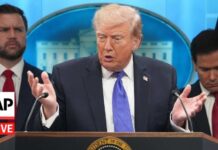

President Trump called Vladimir Putin “my friend” in public, then his own intelligence chief couldn’t say if that makes Putin a friend of America.
Story Snapshot
- Trump greeted Putin in China, pointed at him, and said, “He’s my friend,” then posted dozens of photos calling him a friend.
- CNN’s Dana Bash asked Director of National Intelligence Jay Clayton twice if Putin is a friend of the United States.
- Clayton dodged at first, then said Putin “is not America’s friend in Ukraine. Not at all.”
- Trump himself said, “I can’t speak to America,” when asked the same question about Putin.
- The summit focused on reducing nuclear risk among three nuclear powers, with no breakthrough on Ukraine or Iran.
Trump’s Friendly Words Spark Debate
Trump met Putin at an Asia-Pacific Economic Cooperation summit in Shenzhen, China. He smiled, extended his hand, and said, “Who is he? He’s my friend.” He added that he and Putin “had a great relationship for many years” and had known each other a long time.
Trump then posted dozens of photos of himself with Putin and Chinese leader Xi Jinping on Truth Social. He called them “friends” across a 35-post sequence and compared the summit to the 1945 Yalta Conference, where wartime leaders carved up postwar Europe. Critics said the warm images risked overshadowing Russia’s war in Ukraine, which has killed tens of thousands of people since 2022.
Intelligence Chief Avoids a Direct Answer
Bash pressed Clayton on CNN’s “State of the Union” about whether Putin counts as a friend of the United States. Clayton first replied, “Dana, in different contexts, you can use a different word,” and pivoted to praising the summit’s outcome. He said bringing the three largest nuclear powers together to agree not to escalate tensions was “historic” and “remarkable.”
When pushed again, Clayton offered more clarity. He said the “friend” label fit the narrow context of nuclear powers avoiding a dangerous incident, but drew a hard line on Ukraine. “He is not America’s friend in Ukraine. Not at all,” Clayton said, separating Trump’s personal rapport from Russia’s ongoing war against its neighbor.
Trump Draws His Own Line
Trump made a similar distinction himself days earlier. Asked whether Putin is a friend of the United States, Trump said, “I can’t speak to America. I consider him to be somebody that I have a very good relationship with. It’s actually very good”. The comment echoed a 2022 phone call in which Trump called Putin “a friend of mine” while discussing Russia’s invasion of Ukraine.
Roll Call reported that Trump’s approach reflects his belief that personal relationships with leaders like Putin and Xi can be “bent toward U.S. interests”. Supporters argue warm diplomacy opens doors that formal channels cannot. Critics counter that the friendly language risks blurring the line between tactical charm and real alignment on issues like Ukraine.
What the Summit Actually Delivered
NBC reported that Trump, Xi, and Putin agreed on four points, including reducing the risk of nuclear war. Putin said the three nations share “responsibility for maintaining international peace and security”. The summit produced no public commitments on ending the Ukraine war or addressing Iran, leaving the war’s core disputes unresolved despite the friendly imagery.
BREAKING: In a stunning moment, CNN's Dana Bash just PRESSED Trump's intelligence director twice on whether Putin is "a friend of the United States." He dodged both times. Trump calls Putin a friend and his intel chief won't say. Every American needs to see how insane this is. pic.twitter.com/9JCs2Fox2E
— Democratic Wins Media (@DemocraticWins) November 22, 2026
History offers a mixed verdict on leader-to-leader charm. Franklin Roosevelt’s warmth toward Joseph Stalin didn’t stop Soviet control of Eastern Europe after Yalta. George W. Bush’s early trust in Putin didn’t prevent Russia’s 2008 invasion of Georgia. Personal rapport between presidents and Moscow has repeatedly failed to outlast shifting national interests, a pattern that stretches back decades before Trump’s current approach.
The exchange between Bash and Clayton captured a tension many Americans already feel. Voters across the political spectrum want leaders who can prevent nuclear conflict without appearing to excuse an ongoing war. Whether Trump’s friendly language with Putin reflects smart diplomacy or a troubling blurring of lines will likely stay a live question as the Ukraine war continues.
Sources:
© prospernews.net 2026. All rights reserved.