

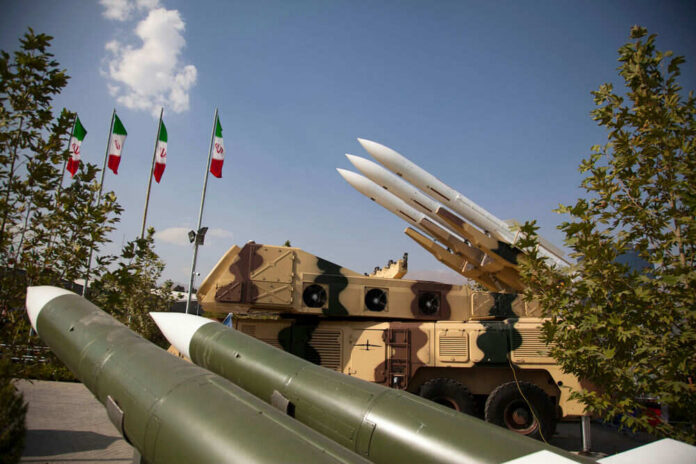
(ProsperNews.net) – Iran’s underground “missile cities” are a hard reminder that even America’s unmatched airpower can be blunted by rock, depth, and decades of preparation.
Quick Take
- Iran’s Revolutionary Guard has built a wide network of fortified underground missile facilities designed to survive airstrikes.
- Reports and satellite-derived assessments indicate many underground sections remain operational even after recent Israeli strikes.
- Analysts say extreme depth and protective mountain cover can limit the effectiveness of conventional bunker-busting weapons.
- The result is a stronger Iranian “second-strike” posture that complicates U.S. and Israeli planning and increases regional risk.
Iran’s underground buildout is aimed at surviving the first punch
Iran’s Islamic Revolutionary Guard Corps has spent decades carving hardened complexes into mountainous terrain to store, move, and potentially launch ballistic and cruise missiles. Public reporting traces parts of the program back to the late 1980s, when Iran began building domestic missile assembly and production capacity, then expanded into a broader underground architecture. The strategic logic is straightforward: if missiles and factories can’t be reliably destroyed from the air, deterrence becomes harder to break.
Available descriptions portray these sites as more than bunkers. They are depicted as multi-purpose facilities with tunnels, storage “magazines,” and internal transport that can keep operations moving when above-ground nodes are hit. Iran has also used staged footage and official statements to signal that missiles are dispersed and launch-capable from multiple areas. Because many locations and layouts are classified or undisclosed, independent verification is limited to partial imagery, reported strikes, and expert inference.
Why depth and geology can neutralize high-end airpower advantages
Engineering assessments cited in reporting emphasize a basic constraint: penetrating many meters of rock and reinforced structures is far harder than destroying visible surface infrastructure. Analysts describe protective cover measured in dozens of meters and, in some accounts, far deeper excavations. Even when bunker-penetrating bombs are available, they may require repeated hits on the same aim point and still fail if key chambers are placed beyond practical penetration depth.
This gap matters because U.S. and allied air doctrine often assumes the ability to locate, strike, and rapidly assess damage to high-value targets. Underground complexes reduce the confidence of all three steps. If an attacker cannot confirm which tunnels were used, where missiles are stored, or whether production lines survived, the military problem becomes less about “one perfect strike” and more about prolonged campaigns, escalation ladders, and difficult choices that carry political and human costs.
Recent strikes show surface damage doesn’t guarantee mission success
Reporting on 2026 military activity describes Israeli strikes that targeted missile-related sites, with visible damage to above-ground infrastructure in certain areas. Follow-on assessments cited in the research indicate that despite that surface destruction, substantial underground capability may have remained intact. That pattern fits the logic of hardened basing: vents, entrances, power nodes, and support buildings can be hit, while deeper sections survive long enough to preserve missiles, personnel, and the ability to reconstitute operations.
At the same time, claims about exact losses and exact readiness are contested. Iranian messaging has incentives to project invulnerability, while adversaries have incentives to signal effectiveness. The most defensible takeaway from the available research is narrower but still serious: Iran appears to have built enough redundant underground capacity that airstrikes alone may not reliably eliminate its missile force or its ability to rebuild it quickly, especially if the network is dispersed across multiple provinces.
The strategic risk: a stronger second-strike posture raises the stakes
Military analysts describe these missile cities as enabling survivable retaliation, a classic second-strike concept. That pushes adversaries toward tougher options: accept ongoing missile risk, expand target sets, or consider operations beyond airpower. Each option carries downsides. For Americans wary of endless conflict, this is the uncomfortable part—deterrence failures and miscalculation risks rise when both sides believe they can absorb an initial blow and still respond.
For U.S. policymakers in 2026, the broader lesson is about priorities and preparedness. When hostile regimes can harden key military assets beyond easy reach, Washington must lean more heavily on intelligence, missile defense, regional basing, and credible diplomacy backed by strength. Limited government conservatives tend to distrust grand nation-building schemes; this story reinforces why clear objectives matter, because technology alone cannot substitute for strategy when targets are buried deep under mountains.
Iran Built Missile Factories Under Mountains. The U.S. Military Can’t Destroy Them.https://t.co/frCVY3qmZx
— Harry J. Kazianis (@GrecianFormula) April 15, 2026
What remains unclear is how quickly Iran can surge production from protected facilities under sustained pressure, and how many launchers and missiles are truly available after recent exchanges. Those details are inherently difficult to confirm from open sources. But the trend is clear enough for voters across the spectrum: as rivals harden and adapt, Americans are again confronting the cost of decades of global commitments, the limits of military tools, and a federal system that often struggles to deliver steady, transparent strategy without drifting into crisis management.
Sources:
The key to Iran’s military response: missile cities hidden inside the mountains
Iran’s underground missile bases immune to Israel’s attacks
Iranian underground missile bases
Copyright 2026, ProsperNews.net