
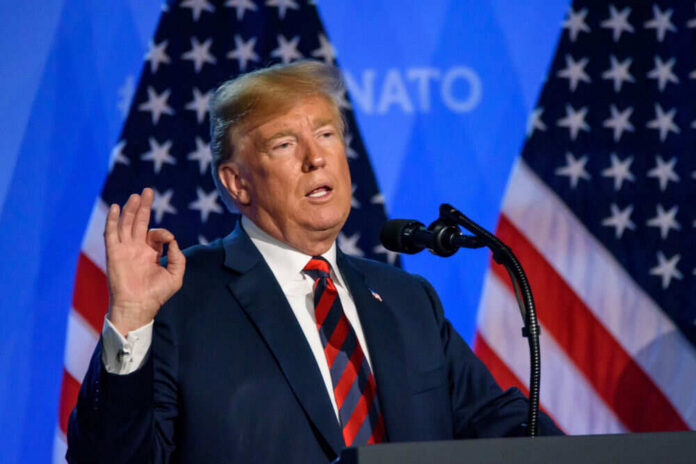
(ProsperNews.net) – President Trump’s threat to walk away from NATO is colliding head-on with a second-term reality many voters didn’t sign up for: another Middle East war with Americans paying the bill and allies refusing to share the risk.
Story Snapshot
- President Trump said he is “strongly considering” U.S. withdrawal from NATO after key allies declined to support U.S. operations tied to the Iran war and the Strait of Hormuz.
- European governments, including the U.K., have emphasized they were not consulted on the campaign and argue “this is not Europe’s war,” limiting cooperation to defensive postures.
- Secretary of State Marco Rubio echoed the White House line, arguing the alliance is becoming a “one-way street” and should be re-examined after the conflict.
- The standoff comes amid heightened energy-market sensitivity because the Strait of Hormuz handles roughly 20% of global oil, raising costs for working families.
Trump ties NATO membership to Iran war burden-sharing
President Donald Trump, in an interview published April 1, 2026, said U.S. membership in NATO is now “strongly considering” withdrawal—at points described as “beyond reconsideration”—because allies are not backing U.S. actions connected to the war against Iran. The dispute centers on requests for warships and other help to keep the Strait of Hormuz open, a chokepoint with major consequences for global oil flows and U.S. energy prices.
Trump’s latest criticism differs from his earlier NATO fights over defense spending because it is tied to an active military campaign rather than long-term budget targets. Reports describe him calling NATO a “paper tiger” and arguing adversaries recognize weakness when allies won’t act together. For many Americans—especially those wary of endless overseas missions—the moment also exposes a contradiction: the administration is demanding allied help for a war that parts of the base question in the first place.
Europe’s refusal: bases, airspace, and “not our war” messaging
European resistance has been concrete, not rhetorical. Reports cite instances where the U.K. initially refused U.S. use of bases for strikes on Iran, while Spain denied base access and closed airspace. Other countries, including France and Italy, are described as withholding support based on legal or strategic constraints. The result is a widening transatlantic rift, with European leaders signaling de-escalation and insisting they were not brought into the decision-making behind the offensive operations.
U.K. Prime Minister Keir Starmer defended NATO publicly as “the most effective alliance ever,” while simultaneously emphasizing Britain’s non-involvement in the Iran conflict beyond protecting its own interests. EU foreign policy voices have similarly framed the conflict as outside Europe’s mandate. This split matters because it undercuts the usual NATO expectation of solidarity—yet it also reflects a political reality on the continent: voters and parliaments are reluctant to be pulled into a U.S.-led Middle East campaign they didn’t authorize.
Rubio and the “one-way street” argument—plus legal limits
Secretary of State Marco Rubio added fuel on March 31 by suggesting the U.S. should re-examine NATO ties after the war, characterizing the alliance as too often operating in one direction. That argument resonates with Americans tired of writing checks overseas, but it also raises practical questions: how much of this is negotiation pressure versus a real move toward withdrawal. Reporting points to legal experts noting presidential authority is significant, but that Congress could push back on a full departure.
Energy, markets, and the kitchen-table stakes of Hormuz
The Strait of Hormuz is not an abstract geopolitical talking point. Reporting highlights that roughly a fifth of global oil transits the strait, so disruptions hit prices quickly and ripple into inflation-sensitive basics like groceries, shipping, and home energy. Trump has also claimed Iran asked for a ceasefire and suggested a short timeline for an end to the war, which other reporting says helped move markets. Still, that ceasefire claim is not independently confirmed in the provided sources.
What this means for MAGA voters: alliance fatigue meets war fatigue
This episode lands in the middle of a growing split on the right: many voters still support an “America First” posture that demands reciprocity from allies, while others are more focused on avoiding new wars altogether. The available reporting shows Trump framing NATO as failing a test, but it also shows allies framing the Iran campaign as optional and externally imposed. If the administration escalates alliance threats while the conflict drags on, the political risk is obvious: war fatigue, high energy costs, and distrust of open-ended commitments.
For constitutional conservatives, the most important takeaway is that rhetoric about leaving NATO is not the same as a lawful, durable policy shift. The reporting emphasizes uncertainty about seriousness and process, with analysts pointing to legal and political hurdles. Meanwhile, the practical pressure points remain immediate: whether U.S. forces can keep maritime routes open without partners, whether the conflict expands, and how quickly the White House can align its promises—especially on avoiding new wars—with the realities now unfolding.
Sources:
https://www.foxnews.com/politics/trump-nato-withdrawal-iran-war-allies
https://time.com/article/2026/04/01/trump-considering-pulling-us-out-of-nato-iran-war-legal-options/
https://www.livenowfox.com/news/can-trump-leave-nato
Copyright 2026, ProsperNews.net