
(ProsperNews.net) – Even as Washington surges America’s most advanced stealth fighters toward Iran, the bigger shock for many Trump voters is this: the “no new wars” promise is colliding with a widening Middle East mission that still lacks clear, publicly verified end-states.
Quick Take
- Open-source reporting shows a major U.S. airpower buildup near Iran, but does not confirm a formally declared “Iran War” in the way viral claims describe it.
- F-22 Raptors are optimized to deter or defeat Iranian aircraft, while F-35s are built to find targets, suppress air defenses, and enable precision strikes.
- Reports say U.S. F-22s deployed to Israel’s Ovda base as part of the surge, while more fighters flowed through Europe toward the Middle East.
- Claims that Iranian defenses hit a U.S. F-35 remain unverified in the provided research and should be treated cautiously until corroborated.
Stealth buildup is real, but the “war narrative” remains murky
Reporting in late February 2026 documented a rapid increase in U.S. and allied air assets positioned for potential operations against Iran, including fifth-generation fighters and enabling aircraft. Public accounts describe deployments and staging moves—such as fighters moving into Israel and Europe—more clearly than they describe sustained, officially confirmed combat operations. That distinction matters for citizens who remember how quickly limited missions can turn into open-ended commitments with unclear benchmarks.
Air & Space Forces Magazine reported F-22 Raptors deploying to Israel with additional fighters also moving through Europe, consistent with a readiness posture intended to deter Iran or support strikes if ordered. Separate reporting described additional aircraft—fighters and support platforms—flowing toward the Middle East. The available research, however, repeatedly flags that the most dramatic “Iran War” framing is not matched by a single definitive, mainstream confirmation of a new, fully declared air war across the region.
Why the F-22 and F-35 are paired: “keep them away” vs. “find and destroy”
Defense reporting and analysis consistently describe the two-jet pairing as complementary. The F-22’s core job is air superiority—denying enemy fighters the ability to contest U.S. and allied operations. The F-35’s job set is broader: sensor fusion, stealthy strike, and hunting targets while coordinating other assets, including fourth-generation fighters and standoff weapons. In the Iran context, analysts emphasize Iran’s aging fleet—often described as legacy platforms—facing a steep disadvantage against stealth and advanced sensors.
Some analyses highlight upgrades and concepts that reduce the “time to decide” in fast-moving combat, including AI-assisted identification and improved sensing. Those claims fit a larger Pentagon trend: pushing more automation into sorting threats and sharing targeting data across networks. For constitutional-minded Americans, the policy question becomes less about the jets themselves and more about who authorizes escalation, how transparent mission goals are, and whether Congress and the public are being kept fully informed.
What the late-February deployments actually show
Multiple outlets reported concrete movement timelines: F-22s headed to Israel around Feb. 24, and a larger package of fighters arriving at RAF Lakenheath around Feb. 26, with the Middle East as the apparent destination. The Aviationist and Militarnyi described reinforcement flows including fighters and key enablers like AWACS. These facts point to preparation for high-end operations—air dominance, long-range strike support, and air-defense suppression—rather than a symbolic presence mission.
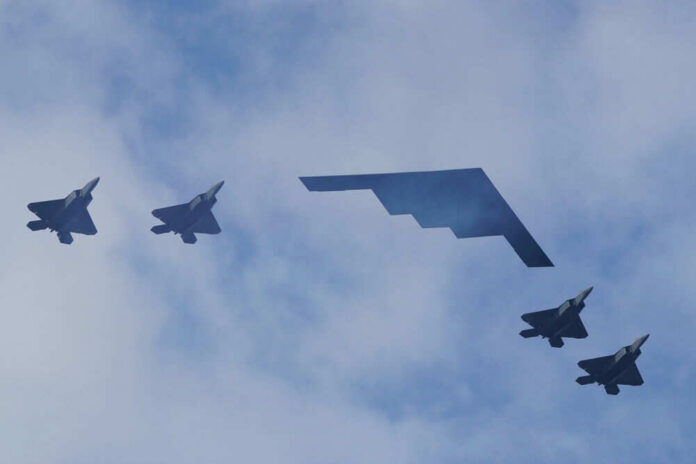
Analyses also reference an earlier precedent: a June 2025 operation described as involving stealth fighters escorting B-2 bombers for strikes on Iranian nuclear sites. In practical terms, that kind of mission relies on layered protection—stealth aircraft to blunt air defenses, maintain air dominance, and support targeting. That history helps explain why today’s buildup is drawing attention: it resembles a posture designed for real combat power, not just diplomacy-by-flyover.
Unverified “F-35 hit” claims highlight the fog—and the stakes
Some content circulating online claims Iranian air defenses hit a U.S. F-35, forcing an emergency outcome. In the provided research, those claims are explicitly described as unconfirmed and are tied to lower-credibility formats rather than corroborated official statements or consistent, independent reporting. If such an incident were verified, it would be operationally significant, but citizens should separate what is documented—deployments, basing, and force packages—from what remains allegation.
America Has Both the F-22 Raptor and F-35 Lightning II Fighting in the Iran War — One Is Keeping Iranian Aircraft Away While the Other Finds and Destroys Targetshttps://t.co/Y2pMJD3rh9
— 19FortyFive (@19_forty_five) March 25, 2026
For a conservative audience split between hawks and anti-intervention voters, the key takeaway is accountability. A major air buildup can deter conflict—or slide into it—depending on rules of engagement, political objectives, and how leaders define “victory.” With energy costs, deficits, and years of public distrust after prior regime-change adventures, the demand now is simple: clear objectives, constitutional war powers respected, and a plan that doesn’t mortgage America’s future to another endless Middle East campaign.
Sources:
US Sends F-22s to Israel, F-35s and F-15Es to Europe in Buildup as Iran Tensions Rise
USA Deploys F-35s, F-22s and AWACS Aircraft to the Middle East
U.S. Upgrades F-35 & F-22 Stealth Jets As It Prepares For Potential Conflict With Iran
Additional Fighters Reinforce U.S. Buildup
Copyright 2026, ProsperNews.net