

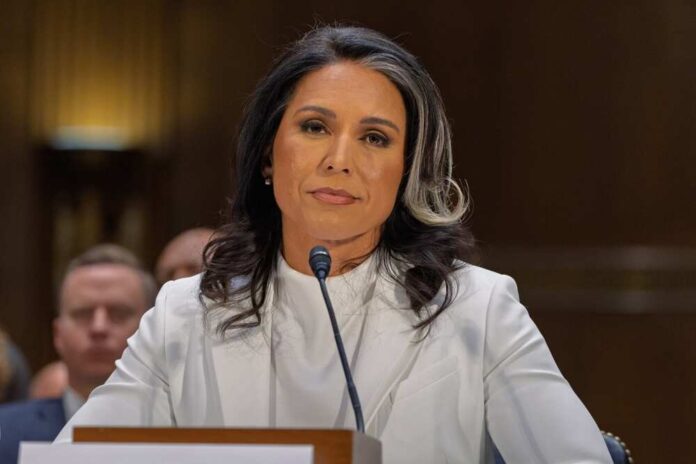
(ProsperNews.net) – A single blunt question now echoes through the halls of American intelligence: Can a 40% workforce cut and a war on bureaucracy really resurrect trust in the nation’s spies, or will it hand the keys to unchecked power elsewhere?
Story Snapshot
- Tulsi Gabbard, America’s first female combat veteran DNI, launches an unprecedented 40% workforce reduction and mission overhaul at the ODNI with Trump’s mandate.
- After two decades of mission expansion, Gabbard axes redundant centers and promises to refocus on core intelligence integration—with $700 million in annual taxpayer savings projected.
- Supporters hail this as the long-awaited “deep state” purge; critics warn of weakened oversight and unchecked CIA power.
- The reforms’ success or failure may reset the balance of power and trust in U.S. intelligence for a generation.
Gabbard’s Appointment and the Greenlight for Reform
February 2025 marked a watershed moment in Washington’s power calculus. Tulsi Gabbard, newly sworn in as Director of National Intelligence, entered the ODNI not as a caretaker but as the agent of disruption. With President Trump’s explicit blessing, she was tasked with nothing less than the agency’s first root-and-branch overhaul since its creation in 2004. Gabbard’s mandate was clear: slash bureaucracy, cut payroll by nearly half, and surgically excise the bloat that had metastasized over two decades. The old guard was put on notice, politicization, inefficiency, and the so-called “deep state” culture would face a reckoning.
Gabbard’s confirmation was no fait accompli. Senate hearings bristled with tension, as legislators grilled her on loyalty, reform plans, and the risks of upending the intelligence status quo. By February 12, after a bruising debate, her confirmation was secured, propelled by a coalition of Trump loyalists and reform-minded centrists. Within weeks, staff reductions began, targeting overlapping mission centers and DEI initiatives. The message: focus, discipline, and accountability would replace mission creep and ideological drift. ODNI employees, long shielded by civil service inertia, suddenly faced an existential threat to their livelihoods and the very identity of their institution.
The Historical Backdrop: From Post-9/11 Integration to Bureaucratic Overload
The Office of the Director of National Intelligence was born in crisis. In 2004, the failures of 9/11 forced Congress to create a central coordinator for the CIA, FBI, NSA, and the other 15 agencies that form the U.S. intelligence community. The early hope: end the turf wars, unify threat assessment, and prevent another catastrophic blind spot. But as years passed, the ODNI ballooned. Mission centers multiplied. Staff counts soared. Critics—inside and outside government, warned of a new problem: a lumbering super-bureaucracy, more focused on process than results.
By the mid-2010s, whispers of “deep state” interference and politicized intelligence turned into public outcry. Congressional hawks, including Senator Tom Cotton, called for drastic cuts. Yet, until Gabbard’s arrival, all previous reform attempts fizzled. The ODNI, meant to solve rivalry, had become a symbol of government inertia. President Trump’s 2024 reelection campaign seized on this, promising a purge and a return to common-sense intelligence. Gabbard’s appointment was not just strategy, it was a message.
The Overhaul Unfolds: Layoffs, Mission Cuts, and Uncertain Futures
August 2025 brought the public face of “ODNI 2.0.” Gabbard stood before the press and declared an immediate 40% reduction in ODNI staff, elimination of redundant mission centers, and a return to the agency’s roots, pure intelligence integration. The projected savings: $700 million a year. Early casualties included diversity initiatives, experimental analytics, and advisory councils that had proliferated in the name of modernization. For the remaining staff, morale wavered between grim determination and outright anxiety. Gabbard, echoing both her military discipline and Trump’s populist rhetoric, insisted these cuts were “not just about saving money, but about saving trust.”
The intelligence community braced for aftershocks. Some insiders warned that a leaner ODNI might fail to check the ambitions of powerful agencies like the CIA, risking a return to pre-9/11 silos and unchecked executive action. Others argued the bloat had become its own threat, slowing real-world response and eroding public confidence. Gabbard’s defenders pointed to Congressional gridlock and past reform failures as proof that only a dramatic reset could work. The stakes were clear: national security, taxpayer dollars, and the very legitimacy of America’s intelligence apparatus.
Impact, Risks, and the Battle for Future Trust
The immediate impact is as visible as it is painful. Thousands of ODNI employees are out of work, and the survivors navigate a transformed agency with higher expectations and fewer resources. Integration processes are being rebuilt from the ground up, faster, Gabbard insists, but not at the expense of oversight. Congressional oversight committees watch warily, some demanding even deeper cuts, others fearing chaos or overreach by the CIA and NSA.
Long-term, Gabbard’s success or failure will set a precedent. If ODNI 2.0 delivers efficiency and renewed public trust, expect a wave of similar reforms across federal agencies drowning in bureaucracy. If it falters, critics will claim the “purge” gutted expertise and left America exposed. For now, the only certainty is uncertainty, and a nation watching to see if the boldest intelligence reform in a generation can truly deliver on its promise.
Copyright 2025, ProsperNews.net