

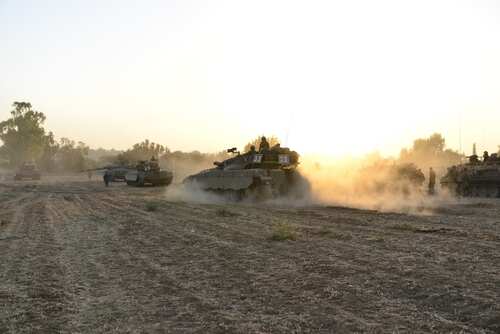
(ProsperNews.net) – A US military team of 200 people will be deployed in the Middle East to “oversee” the Gaza ceasefire between Israel and Hamas after a peace deal brokered by President Donald Trump, senior US officials said Thursday.
Story Highlights
- 200 US troops will be sent to monitor and enforce a fragile ceasefire between Israel and Hamas in Gaza.
- The deployment follows a high-stakes diplomatic breakthrough brokered by President Donald Trump.
- This marks the first major US military presence directly involved in Gaza conflict oversight in decades.
- The mission’s success hinges on balancing neutrality with the need to prevent renewed hostilities.
- The move signals a dramatic shift in US policy, placing American boots on the ground in one of the world’s most volatile regions.
Why 200 US Troops Are Headed to Gaza
Senior US officials confirmed that a team of 200 military personnel will soon arrive in the Middle East to oversee compliance with the newly brokered Gaza ceasefire. This deployment, unprecedented in recent memory, aims to provide a tangible US commitment to the peace process and deter violations by either side. The decision reflects a calculated risk, putting American servicemen and women in harm’s way to stabilize a region where ceasefires have historically been short-lived and fraught with distrust.
The announcement comes just days after President Donald Trump personally intervened to negotiate the deal, leveraging his administration’s relationships with both Israeli and Palestinian leaders. The presence of US troops on the ground is intended to serve as both a symbol of American resolve and a practical mechanism for monitoring adherence to the ceasefire terms. Critics argue that the move could entangle the US further in the region’s intractable conflicts, while supporters see it as a necessary step to break the cycle of violence.
The Challenges of Ceasefire Oversight
Overseeing a Gaza ceasefire is no ordinary mission. The region’s history is littered with broken truces, covert operations, and sudden escalations. The US team will need to navigate a complex web of local alliances, militant factions, and competing narratives. Their mandate includes verifying compliance, reporting violations, and facilitating communication between the parties, tasks that require both diplomatic finesse and military preparedness.
Previous international monitoring efforts in Gaza have struggled with accusations of bias, limited access, and the constant threat of violence. The US deployment aims to address these shortcomings by providing a neutral, yet authoritative, presence. However, neutrality is easier declared than achieved. The team’s every move will be scrutinized, and any perceived misstep could reignite tensions or undermine the credibility of the peace process.
The Broader Implications for US Middle East Policy
This deployment signals a significant shift in US strategy. For decades, American policy in the region has focused on diplomacy, intelligence sharing, and indirect support. Placing troops directly in Gaza represents a departure from that approach, reflecting a willingness to assume greater risk for the sake of stability. The move also raises questions about the long-term US role in the Israeli-Palestinian conflict, will this be a one-off intervention, or the start of a deeper engagement?
Domestically, the decision has sparked debate. Some argue that the US has no business policing a conflict with such deep historical and ideological roots. Others counter that American leadership is essential to prevent another cycle of violence that could destabilize the region and threaten global security. The success or failure of this mission will likely influence future US foreign policy decisions, both in the Middle East and beyond.
What Success Would Look Like, And the Stakes of Failure
A successful mission would see the ceasefire hold, violence decrease, and trust between the parties gradually rebuilt. This could pave the way for broader negotiations and, ultimately, a more durable peace. But the stakes of failure are high. A breakdown in the ceasefire, especially under US watch, would damage American credibility and could lead to a rapid escalation of hostilities. The presence of US troops also increases the risk of American casualties, which would have profound political and emotional repercussions at home.
The coming weeks will test the resolve of all parties involved. For the US team on the ground, the challenge is to project strength without provocation, and impartiality without indifference. For the region, this moment offers a rare opportunity to step back from the brink, if the ceasefire holds, it could mark the beginning of a new chapter in one of the world’s most enduring conflicts.
Copyright 2025, ProsperNews.net